


podcast
All There Is with Anderson Cooper
Grief can feel so lonely but talking about it and listening to others share their experiences helps. In all new episodes of this award-winning podcast, Anderson Cooper continues his deeply personal exploration of grief in all its complexities. In moving and honest discussions, he learns from others who have faced life-altering losses. Join the community to share your story and watch Anderson's weekly streaming show All There Is Live at cnn.com/allthereis
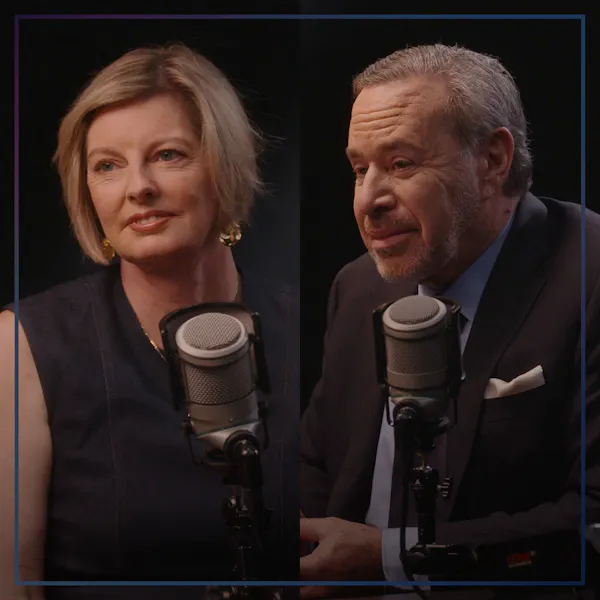
Grief Is Not A Problem To Be Solved
All There Is with Anderson Cooper
Aug 6, 2026
Journalists Danielle Crittenden and David Frum's 32-year-old daughter, Miranda, died unexpectedly in 2024 from complications related to a brain tumor she had survived several years earlier. They talk with Anderson Cooper about the loss of a child and how grief transformed their marriage and made them “different people.” For more of “All There Is with Anderson Cooper” visit cnn.com/allthereis.
Host: Anderson Cooper Showrunner: Haley Thomas Producers: Emily Williams and Kyra Dahring Video Editors: Eric Zembrzuski and Nathaniel Little Technical Director: Dan Dzula Bookers: Kerry Rubin and Kari Pricher
Episode Transcript
Anderson Cooper
00:00:01
Welcome to All There Is. Wherever you are in the world and in your grief, I'm glad you're here. You're not alone. My guests today are David Frum and Danielle Crittenden. They're both journalists and writers who've been married for 38 years. They've had three children together, Miranda, Nathaniel, and Beatrice. Miranda, their eldest, worked as a journalist and model before she died unexpectedly. She was diagnosed with an advanced brain tumor in 2018. She'd had surgery, which was successful, but in 2024, she died from complications relating to it. She was 32 years old. David Frum is a staff writer at The Atlantic. Weeks after Miranda died, he published a piece titled "Miranda's Last Gift" about his daughter and caring for the dog she left behind, Ringo. Danielle has just published a moving memoir, "Dispatches from Grief: A Mother's Journey Through the Unthinkable." I sat down with David and Danielle and her service dog Lulu in New York.
Anderson Cooper
00:01:00
You write that you thought you knew grief. What did you not know?
Danielle Crittenden
00:01:06
'Well, David and I both lost parents. David lost his mother early, at age 54, to leukemia. I've lost a father, I've lost a stepfather. But parental death feels in the natural order of things. As a child, at some level, you know you're going to outlive your parents. So when you lose a child it not only upends the universe and your universe, but it was a grief with a capital G. I had no idea I could be in such pain, physical and emotional. We don't often talk about the physicality of grief and how it was like waking up with an ice pick going into my chest every morning. Your thoughts are just overcome of the non-acceptance of the child not being there anymore. And that is very hard to process. And I don't think as a mother or father you ever do process that. Two days before she died, unexpectedly, she was getting ready to go out to an event. She selfied me a very glamorous outfit that she was going to wear. And, that was the last text I got from her. And three days after that, I'm sitting in front of a computer online with a funeral director saying, which coffin do you want for your daughter? And the surrealism of it cannot be underscored.
David Frum
00:02:49
'And you thought you had won the race with Miranda. She had been diagnosed as very seriously ill with a non-cancerous but dangerous brain tumor. This was identified at the end of 2018.
Danielle Crittenden
00:02:58
Well, it's a very rare, rare tumor we discovered.
David Frum
00:03:01
And the operation took place in April 2019, and it was very grueling. We were there for hours, 10 hours, at Stanford Medical Center with little Ringo Miranda's dog with burying our faces in his fur, but she came out.
Danielle Crittenden
00:03:15
It had consumed her pituitary gland, but the surgeon was like, you can medicate for this, you can live a full life. But you know, you then go to the endocrinologist and it's not so, the cocktails of hormones and things that you have to take and their side effects. She had reactions, finally she got to a point where she thought she had it right and she had a catastrophically wrong. What none of her doctors told her was, hey, if you low dose too much on your cortisol, you could drop dead. Like, no one said that to her. Before she died, she was looking very, very pale to me, and I told her so, and she said, yeah, well, I've had this cold for two weeks. She seemed perfectly normal. It obviously never occurs to you that one day you could wake up and they'd just be gone.
David Frum
00:04:09
The call came at 10 minutes to 10 on a Friday morning.
Danielle Crittenden
00:04:11
Wait, what, who are you? Why are you in Miranda's apartment? They say, well, she's been found unconscious. The medical examiner was just very blunt. We estimate her time of death at 3 a.m. And they're saying, if you're not here by what, four o'clock, we have to take her away. And I said, where are you taking her? They said, to the medical examiners building. And it was like, okay, that's not the emergency room.
Anderson Cooper
00:04:37
You thought she might still be alive.
Danielle Crittenden
00:04:39
It's some part of my brain, yes.
Anderson Cooper
00:04:42
David, in a lovely article you wrote about her dog, Ringo, you said, sooner or later, you're gonna join the community of suffering.
David Frum
00:04:49
Yeah.
Anderson Cooper
00:04:51
I love that phrase, the community of suffering.
David Frum
00:04:53
'There are those who are in grief, and the rest of humanity I now call pre-grief, because it's coming. This is the most human thing about us, the most universal experience. At any given moment, there are people who are the deepest part of it. And we continue to get mail from people who it's an anniversary, or we're within two months of the loss of a loved one. And there's more of it than you could ever possibly imagine.
Danielle Crittenden
00:05:16
You suddenly join this alternative universe, the land of grief. And when you get there, deported there, you look around you and you suddenly discover how many people are here, and also people you thought you knew really well. And that only then do they open up and they say things like, oh yeah, when I lost my sister, when I was 18, or a hairdresser we'd had for 10 years, he was from Lebanon, and he only then told me that he'd seen his brother and father shot at point blank when he was nine years old. But then you think, well, why would they tell you? Because what are you going to say except, oh, my gosh, that's so awful. Oh, dear, I'm so sorry. But you can't feel it unless it's happened to you. The world moves on. Your friends move on. And you don't move on. And you can't move on, but there becomes, you sense this kind of expectation around you. Well, it's been a year. Must be what at acceptance about now, having gone through denial. Like, and you realize there's also no stages to this kind grief.
David Frum
00:06:31
'Show an American a problem, and the American response is, there's an answer here, we can develop the resources and build our contraptions and find our way out. And much of the help that is offered to people who have lost such an intimate person is of the problem-solving variety. Grief is a problem. There are steps, there are things you can do. There are blank pages in the book where you can do the work exercises. Perhaps you'll become a better person.
Anderson Cooper
00:06:57
I hate those work exercises, I gotta tell you. I skip over those parts in those books.
David Frum
00:07:02
'But it's not a problem to be solved, it is the condition in which you must find a way to endure. If you live in a problem-solving culture and you're told that your grief is a problem that you should overcome and at the end ideally become a better person, and you fail to do that, well then you're some kind of grief failure. You haven't learned the lesson, you haven't gotten the benefit that you should get from this terror...
Danielle Crittenden
00:07:21
You haven't gotten through it, this whole idea that there's your normal life resuming once you get through the weeds, you know, you'll go back to feeling normal. I think from all, from our experience and from everyone I've spoken to who is even further, much further along, you don't get through it.
Anderson Cooper
00:07:40
You also talk about that question, oh, do you have any kids?
Danielle Crittenden
00:07:45
'Oh yeah. The most routine, non-fraught, conversational gambits. I just go into inner seizures. Somebody says, you meet another mother. Oh, how many kids do you have? Do I say three? I'll say three. Or I could say two. If I really am not gonna see this person again, I'll stay two. But if it's somebody I'm gonna be closer to, I'll see three. And then I'll immediately turn it back to them. And I will try and dodge any further inquiry as long as I possibly can and then when you finally can't, like they press, you'll say, well, we lost our eldest daughter at 32 and then they look so stricken and embarrassed that you feel bad for them and then you start to comfort them and you just say no, no, of course, you didn't know, it's fine, it is fine, but it's nothing is normal. Again, these types of common interactions.
Anderson Cooper
00:08:43
'I found the same thing with people say, oh, do you have any siblings? For a while, I found myself coming up with this formulation that would try to make them feel better immediately. So I would say, I had a brother, but he died, but I have two half-brothers. I would throw that out to sort of make the other person comfortable.
Danielle Crittenden
00:09:02
'But then, in that situation, also, am I now negating my relationship with my brother? Like, yes, we lost our eldest, but it's okay. We have two other children. And with a child, it's something you don't want to let go of. I say to David, I miss my variety pack. Like, you've formed this family unit over 32 years, and Miranda played a role, Nat plays a role, Bea, we play roles, they evolve over time. But once that person is gone and the hole is blown in your family, it's a whole reshuffling of the dynamics of your galaxy. Miranda was very adventurous, very beautiful. She modeled for a few years based in Tel Aviv. She put out this exceptionally cool, like, persona. But she could talk to anyone, and not only could she talk to anyone, she could get right to their essence. And she liked oddballs. She liked creative people. She liked unusual people. Her friends began to call the people she collected sometimes Miranda's strays because they all were a little troubled, but they found kindredship in her. And she was able always to bring out the piece of gold that was in them. There was a 10-year gap between Bea and her sister Miranda. Miranda was just like the cooler mother. And it was a very intense loss. Bea pointed out to us the other day that she had to face 60 years without her sister. You know, I guess we only have to face 20 years. But yeah, she's like the whole stretch, because she's now 24, so she was 22. The whole stretch of her life, any celebrations, any weddings, any children, she will not have that best friend and mother by her side. Bea wrote a lot about what was going on, and she writes very movingly about what it was like to suddenly not have her parents cope well with something like this.
Anderson Cooper
00:11:18
I wanna read that. She talked about a visit you made to her at college. You write, Bea would later recall her father visiting her at college nine months after Miranda died. She wrote, "Over dinner I told him how painful it was to see him and my mom like this. I wanted to know if there was something else I could do. He answered, Your mother and I will never be our former selves. Miranda's death is the defining fact of the rest of our lives. But it is different for you. This isn't the defining moment. It will change you, but you have to keep living in a way your mother and I don't have to do. Our wish for you is to keep living the life you have beyond this."
Danielle Crittenden
00:11:57
As a mother and as a father, but I think especially as a mother, you are so used to putting your children first and their needs first. And so when Miranda died, I just crawled under a rock. Our children had to watch me crying, howling crying. It was the first time I felt utterly unable to comfort them. I mean, I tried, but I lost all capacity to be, it felt to me like a mother. And not only that, I felt I was being cruel and selfish because the most natural thing in the world is to hold them and tell them it's going to be okay. I couldn't do.
Anderson Cooper
00:12:45
You said, "The loss of a child upends the natural order, a meteor crashing into your personal galaxy. The universe as you knew it is destroyed forever. However unique and precious your own loss feels, you've discovered that you've simply joined the limping thousands, millions whose lives have been devastated by the routine catastrophes that befall someone somewhere every second of every day. From these fellow travelers, we learned what no grief manual will tell you. The person you were died with your child. There is no healing. No journey back to yourself. That map burned with everything else. On that February morning, we became entirely different people wearing the same faces." Do you still feel like entirely different people?
Danielle Crittenden
00:13:27
'Yeah, yeah, I mean obviously there are parts of you that remain. I mean you are you. But I don't think I can experience joy or happiness the way I used to in a completely unmitigated way. Everything will be offset or tinged with sadness. I realize that that sounds very pessimistic and not a lot of fun, but I'm finding I'm learning to cope with that. And what you try and learn to do, and what I'm definitely becoming better at, is just simply being in the present, sitting with your friends, laughing, engaging in whatever moment it is. And then the minute you step away, it's like a flare-up of an old war wound. You feel, she's still not here. And that's how I think it's going to be.
Anderson Cooper
00:14:28
There was one other thing you mentioned in the book, which I've always been fascinated by, the idea that you've carried a child and the cells of that child are still inside you.
Danielle Crittenden
00:14:38
'This was a scientific thing I learned a few years ago before Miranda died and then I went and re-looked it up that when a woman gives birth to a baby, some of the cells remain in her body forever.
Anderson Cooper
00:14:52
The cells of that baby.
Danielle Crittenden
00:14:52
The cells of that baby, leaves some of its cells behind. And these cells have been known to help a mother fight illness, cancer, and it's also regarded as one of the few, if only, instances where foreign cells can live compatibly in a completely different person. And so this is something that gives me great comfort because I know then that I carry Miranda's cells with me. So part of her. Part of her literally remains alive in me.
Anderson Cooper
00:15:33
That must be an incredible feeling.
Danielle Crittenden
00:15:34
It's one of the special things about being a mother.
Anderson Cooper
00:15:37
We'll have more in a moment.
Anderson Cooper
00:15:42
The two of you, you had to work to really not retreat into your own silos of grief.
Danielle Crittenden
00:15:48
It was David who recognized that. And every time I tried to just crawl into a ball, you were the one who would pull me back and say, we can't retreat into our own silos of grief. That's when he coined this phrase. And I also saw that he was maybe even nervous about talking about his grief with me. And so as I got a little stronger, I sort of forced you to talk about it with me because I could see you could go into your mind and into your tasks. Then when you did, actually we could talk about it together. It gave me such comfort. And I realized that we were the only two people who understood exactly what the other was going through. And so that's what we leaned into. But it did take enormous effort to do that because you are so ready to just silo yourself off.
David Frum
00:16:54
Yeah, so Danielle and I have been married now for 38 years. Before all this, I used to joke, we've had a lot of marriages. We're the same person. But along the way, the marriages have been different. There's a marriage before children, there was a marriage with young children, there was marriage with mature children, there was marriages and empty nesters. And we became different people along the ways. And now in the wake of this shattering pain, you have to find a new way to be married all over again. And we have changed a lot of our routines. I just do many fewer things than I used to do. I spend more time, we have lunch together, which we didn't typically use to do.
Anderson Cooper
00:17:28
You took your foot off the gas pedal in some regards externally.
David Frum
00:17:32
Yeah.
Danielle Crittenden
00:17:33
I think also you just naturally lose interest in a lot of things too. I lost interest in everything. I stopped writing for sure. I couldn't even read unless it was about grief. Anything I realized that once gave me pleasure I could no longer do. And maybe that was just because for that time I could not longer experience pleasure. And physically, you know, I've become fascinated in the physical toll that grief takes upon you. The whole nervous system gets rattled, your brain has a terrible time processing it, and I write a bit about EMDR therapy for PTSD, which...
Anderson Cooper
00:18:16
Which you found helpful?
Danielle Crittenden
00:18:17
Which I found super helpful. It was the only thing I found helpful. Not least because I couldn't get any other help of any kind because every time I reached out to a grief specialist or grief institution, they were like, yes, we can see you in 18 months. And I'm feeling, no, I want to actually kill myself right now. And I don't know where I'm going to be 18 months from now, but it's very, very hard to get therapeutic help quickly when you need it, unless you check yourself into a hospital and say, I'm going to commit suicide. But, and what was that going to do? That wasn't going to help me.
Anderson Cooper
00:18:53
But you felt that way?
Danielle Crittenden
00:18:54
I suddenly understood, and this feels like a terrible thing again to say as a mother and a wife, but for the first time I understood that pain could be more powerful than living. That death could offer this retreat from the pain and I could go into the ground with Miranda and be with her. And then your brain starts to, yeah, David will be fine, the kids will be fine, but I can't keep living, and it's that bad.
Anderson Cooper
00:19:30
How long did that last for?
Danielle Crittenden
00:19:34
Least three months. And then the EMDR kicked in and it realizes that the brain has a lot of difficulty processing trauma. It doesn't know what to do with it. That your brain regularly files normal memories, it's straightforward. And they've now shown, through the miracles of MRIs that when a traumatic memory hits, the brain starts reacting in completely different ways. Parts of it light up that don't light up with regular memories. And the theory is that the experience remains present. And so when you're reminded the trigger, when I walk through the supermarket and suddenly saw the things I used to buy for Miranda and I had to like run from the building like it was on fire because I couldn't cope with that, it learns to train the brain to file those memories away, and it works.
Anderson Cooper
00:20:38
How long was that treatment?
Danielle Crittenden
00:20:39
I'm still doing it, two years on. The goal when I talked to the therapist, I said, well, what is, especially early on, I said what is really the point of this? Because I'm not going to stop grieving. I'm never going to not miss Miranda. And she said our goal is for the grief to stop controlling your days and to stop controlling your mind. And that really made sense to me and it has proven to be true. I think I'm a lot further along in being able to, like even now, just talk about this in a matter of fact way, which I don't think I could have done without having already gone through a lot of this in therapy.
Anderson Cooper
00:21:24
I want to read something you wrote. You said, "To me, the most infuriating observers are those who insist grief is a gift. Believe it or not, there's no shortage of people who believe that the worst thing that can happen to you is actually an opportunity for growth. The happiness hucksters of TED Talks and TikToks promise that everything is surmountable if you just find your truth and believe in yourself."
Danielle Crittenden
00:21:45
You get a lot of, nine workshops will get you through your grief. And because it's so painful, I mean, you're willing to try anything. I wanted to reach out to psychics, like I just wanted something to stop this pain that no medication could help. Selling you this hope, selling you that you're a better person, I think is the inverse of the message you want to hear.
Anderson Cooper
00:22:10
This idea, the whole gift idea, I talked to Stephen Colbert about this back in 2019. I had come across something he had said in an interview, quoting a J.R.R. Tolkien, who said, "What of God's punishments are not gifts?" He went on to say, in a later podcast I did with him, he said, "Grief can become a form of wisdom about your human experience that you can share with other people."
David Frum
00:22:35
I would say there is truth there, and there is power there, and there wisdom there. But it's not a truth, and it's a power, and it is not a wisdom that we can share or we can use. I've lost both my parents now. And when you lose a parent, whether horribly prematurely, as in my mother's case, or somewhat prematurely in my father's case. They leave behind, in your life, not only a void, but a role. That you can take their parts of their lives, and this is not a robbery, because this is what I see now in a parent. When I die, I will feel the same way. They leave behind things for you to take from them.
Anderson Cooper
00:23:13
That's the role they leave behind.
David Frum
00:23:14
Yes. And in some ways, only when they leave the earth can you fully internalize them, and is the parental role complete. Because you have left behind an example of the whole life.
Anderson Cooper
00:23:24
Even leaving an example of how to die in some cases.
David Frum
00:23:26
Even leaving the example of how to die. And as a child, as sad as you are, and in my mother's case, we were shattered. In my father's case, we were deeply in grief. But they have left behind something for you. With a child, it's not like that. You wanted to leave it for them. If it were Miranda sitting here talking about us, I would be very pleased if I could hear it, to hear her say, my parents' death was in a way a gift, because that's what I would like. I would like to leave both my life and my death as a gift for my children. But this gift, we'd like to return.
Danielle Crittenden
00:23:56
Yeah. And it's nonreturnable.
David Frum
00:23:59
It's nonreturnable. Danielle's stepfather, he had this process. He was in the hospital for about 10 days during the final dying. And he had a word for everybody. He had a joke for everybody, and that's the gift. That's the gift, when you can do that.
Danielle Crittenden
00:24:12
Miranda was also exceptionally close because through a couple of rebellious years of her teenage hood, we eventually just shipped her up to live with my parents. They were in Toronto, Canada and she went to school there. So they became very, very close. And so when we were sort of getting the last messages, Miranda came in and he looked and he said, I'll see you down there. And she reeled and then started to laugh hysterically. And then she came and sat on his bedside, and he held her and he said, I couldn't have loved you more.
Anderson Cooper
00:24:51
And Miranda actually died on his birthday.
Danielle Crittenden
00:24:53
She did die on his birthday, yes. And in some ways we hope that he was maybe there to catch her.
Anderson Cooper
00:25:00
Do you believe in signs?
Danielle Crittenden
00:25:02
I, before this, I might have said, yeah, sure. I now really believe in signs because there are things that happen that are so connected to them and yet completely inexplicable. I often talk to her and I imagine what she would say, but there have been times at critical moments, it's like her voice has landed in my head and said something that I wouldn't have expected her to say, and actually one of them relates to this book. I've been very torn about, you know, promoting it. It's a weird thing to have to keep going out and talking about again and again and repeating the fact that she's dead again and again. And one night as I was falling asleep, I was thinking, well, Miranda, at least this book, you know, keep your memory alive in the world. And then I heard her in her sharp voice and she said, no, mom. That's not what's going to keep me alive in the world. You are going to keep me alive in the world and the only way you will keep me alive is if you live and by live she meant, live. And she was always someone who was joyous and seeking joy and I have also taken that to heart.
Anderson Cooper
00:26:24
Can you do that?
Danielle Crittenden
00:26:26
I'm trying. I'm trying and actually the process of this book and talking about her, I feel her very strongly by my side and I feel it's been her way actually to bring me back into the world. It's the first time I've been able to write again. The article you wrote that was in The Atlantic about Ringo, that was the first time you were able to write again when you thought you couldn't write. There are other more inexplicable signs, but you do feel their spirit. I'm very aware, as obviously you are, of the people around me who may be suffering. And I remember, well, what would Miranda do in this situation? And then I do it.
Anderson Cooper
00:27:07
It's been more than two years. Does that feel like a long time? Does that like a short time?
Danielle Crittenden
00:27:14
It feels like both. I sometimes miss the early grief, as horrible as it was, because I was still closer to her in time. Nothing physically around me had changed. You could almost touch her. And now, and the analogy is your train pulls away from Miranda station. And you get farther and farther along, and things get different and things happen. And suddenly you're really aware of the world that she is not joining you on this journey. And we had just the ultimate joy of a granddaughter recently, and that was just such a great, great bringer of new life. And yet even then I'm thinking, oh, Miranda was so looking forward to being an aunt. She and Nat would talk about pushing strollers to each other's apartment, and just the fact that she would never know this person. Even with these extraordinary life changes and gifts, to use the word, you just don't experience them in the same way. And I think it's also because you know what can happen. You're no longer in the, this could never happen to me or anyone I love mode. Why not me? Why not us? So you just lose that kind of protection that people walk around with in their alternative universe.
Anderson Cooper
00:28:49
You took a trip to Auschwitz and you ended up...
Danielle Crittenden
00:28:54
Haha. Yeah I am sorry. I know the story...
Anderson Cooper
00:28:54
The trip with karaoke.
Danielle Crittenden
00:28:58
We did a family trip to Poland. Miranda would have been about 17. She brought along one of her best friends. And especially being Jewish, you go through Poland and you see all the most depressing parts of Poland. You go to the Warsaw Ghetto, you go to The Jewish Museum. And so this was the last big expedition of our trip before we would fly back to the US. And right down the street from our hotel was a karaoke bar, obviously a Polish karaoke bar. And...
Anderson Cooper
00:29:28
Which are the best kind of karaoke, everyone knows this.
Danielle Crittenden
00:29:30
'No I have to say this was, I don't even, I hadn't even known about karaoke bars, but the minute we walked in we were instantly unpopular because we were obviously English-speaking Americans, but and and why we David and I were there. We don't know. She was just very insistent that to end this tour of tragedy, we had to go to a karaoke bar because that was her spirit. And we went to this karaoke bar and Miranda at all of 17 knows exactly what to do and she starts commanding shots of vodka. Which you, to my total surprise, got heavily into this whole experience. And you don't even like singing. And she queued up, "Don't Stop Believing."
Anderson Cooper
00:30:14
Journey.
Danielle Crittenden
00:30:14
And then we, yeah, and then we. It was our turn, and we're just following Miranda and her friend's lead, and we, you know, mangle the song. And then after a certain point, it became very clear from the surly DJ that it was time for us to leave. I was just like, the funniest story for years, you know, after tragedy, karaoke. That was Miranda's kind of outlook on life. And so at her memorial service, which in Judaism you do a year after they are buried, that's when you, it's called an unveiling, you literally unveil their headstone. So we planned this ceremony for Miranda and her friends came, including this friend who had been on the Polish trip with us, and I was very worried the memorial would end on a very sad note, which in retrospect probably was appropriate. But then I said to her friend, Ari, the night before, over a glass of wine, I said, Ari do you think we should do "Don't Stop Believing" tomorrow at the end of the ceremony? She's like, that's a great idea. And so we then solicited some opinions and there was, her friends were like, you got to do it. We took a speaker, we took a microphone. And after the end of this service, a friend of hers had poured a perfect dirty martini, which was her favorite drink, and had placed it at the beginning of the ceremony on her headstone, which is not part of Jewish tradition, I just want to make that clear. And we keyed up Journey on the karaoke app, and we mangled it just as beautifully as we did before. But this time, everyone gathered and started to sing. Imagine in this beautiful old historical cemetery, these people singing this absurd song. And then we toasted her, and I poured the martini onto her glass, and that was how it was ended. And all I could think of was Miranda sitting over there watching us, bent over laughing. And to me, I don't now care what anyone else thought, it felt like to us the way that we should close that ceremony for her. Miranda, by the way, had amazing taste in music. Every car trip she had the greatest playlist. And after this, Nat was like, I don't think Miranda really loved Journey, like that was not her song.
David Frum
00:32:51
At the gravesite, there is a QR code, which is affixed to a plaque, which you can scan and get Miranda's playlist.
Anderson Cooper
00:32:57
No kidding, really?
Danielle Crittenden
00:32:58
Yeah.
Anderson Cooper
00:32:58
That's an awesome idea.
Danielle Crittenden
00:33:00
All of her friends and us got together and did a playlist of her favorite songs and you can listen to that there and also learn about her. And now people who go and enjoy this garden, which we made for public enjoyment, because Miranda would always like to welcome new friends, they can just learn a little about who she was.
David Frum
00:33:21
Danielle made a beautiful grave site for Miranda, where we will in time follow. And I think we both have a strong feeling of, she is there. And when we're there, you will lie beside her.
Anderson Cooper
00:33:33
You lie down on the grave?
Danielle Crittenden
00:33:35
Yeah, I mean, especially the first summer after, I felt very strongly. I wanted to be able to sit with Miranda. And I thought a wildflower garden, I love gardening, so I thought that suited her. But we go there now, it's in a beautiful, beautiful spot in rural Canada, near our cottage where we spend every summer, where she spent every summer. We have little stools, and I sit and I'll have a glass of wine with her. I'll talk to her. And sometimes I'll just lie down on the ground next to her and I'll feel really close to her. I mean, obviously she's not there, there, but she's there. Even when it's cloudy or looking like rain and I go, the moment I hit her grave, the sun comes on, unfailingly.
Anderson Cooper
00:34:27
Is there something you've learned in your grief that would be helpful for others?
Danielle Crittenden
00:34:30
'Yes, no one ever knows the right thing to say, especially a tragedy of this kind. And I think people are always uncomfortable with anything, saying anything. And really, the right things is to just show up and be there for people. It was the check-ins and the willingness to just sit there and listen to me because I think, especially in those early days, You need to kind of talk and talk, or I do. And just to have the presence of friends was a good thing. People want to comfort you. They hate seeing you in pain. And they try and make it better for you. They try and say, you know, you'll get through this. It will be better. And actually, what you want people to say, this is the worst thing, I'm so sorry. This is terrible. Let me go get you a glass of scotch. You want them to lean into the suck, as it were. And you don't wanna be told how you're gonna feel, how you should feel. You want people to recognize the immensity of what you've lost.
David Frum
00:35:48
'We as human creatures live in time, but this particular emotion exists outside of time. And that's something that if you're in the pre-grief world, that's hard to understand, but the clocks are broken. There are anniversaries that are intense. There are moments that are intense, but this emotion exists without reference to time.
Anderson Cooper
00:36:07
Thank you so much.
David Frum
00:36:08
Thank you.
Danielle Crittenden
00:36:09
Thank you.
Anderson Cooper
00:36:10
'Danielle's memoir, "Dispatches from Grief: A Mother's Journey Through the Unthinkable," is available now. If you have thoughts you'd like to share about my conversation with them or about your own experiences with grief, we'd love to hear from you. You can leave a comment on our Grief Community page at cnn.com/allthereis or leave us a voicemail at 404-827-1805. For the next podcast episode, August 20th, you'll hear my conversation with legendary drummer, Travis Barker. It's a remarkable conversation. He's the sole survivor of a plane crash that killed some of his closest friends. He underwent months of agonizing treatment for third degree burns, which covered more than 65% of his body. And he talks beautifully and candidly about the losses he carries with him.
Travis Barker
00:36:54
Every day life was really hard for me. If I saw a plane come in the sky, I would like hide. Planes are just equal death to me. Leaving the house was just hard. Like I was just waiting for something to happen. Chris and Che are gone. These two pilots passed away. I was in a burn center for six months. Life was hard.
Anderson Cooper
00:37:14
You're a different person.
Travis Barker
00:37:15
'Yeah, it was challenging. And I remember my post-traumatic doctor had said something like, people go through life just expecting everything to be perfect. And not everything's gonna be perfect. Sometimes you're gonna face adversity and you faced some of the worst adversity ever, right? But these things either destroy you or define you. And there was no way I was gonna let it destroy me.
Anderson Cooper
00:37:43
All There Is with Travis Barker comes out August 20th.